

Our innovation focus encompasses the development of new products and solutions as well as product and process improvements that ensure our long-term competitiveness and enable our customers’ green transformation. Another focus is on innovation for more sustainable agriculture.

Four research pillars supporting a structured innovation ecosystem from concept to commercialization.
Rational design of novel compounds through computational modeling and structure-activity analysis.
Dedicated synthesis laboratories equipped for parallel reaction screening and route optimization.
Comprehensive evaluation protocols simulating real-world conditions to validate application performance.
Structured stage-gate process moving ideas from concept through feasibility to commercial deployment.
A stage-gate process moving ideas from identification through synthesis to commercial scale-up.

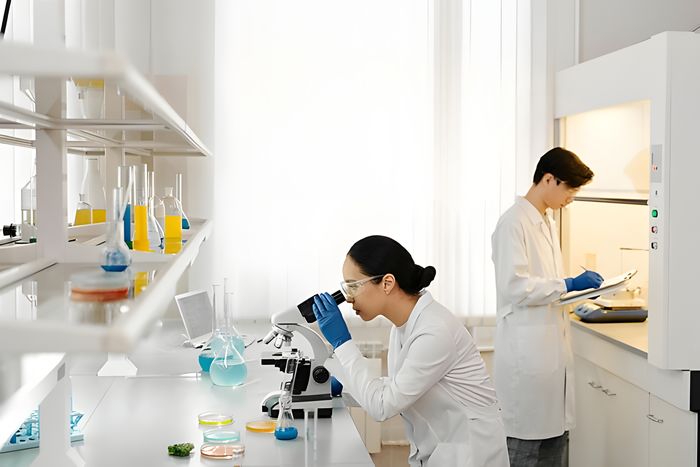
Market analysis and customer needs assessment defining research priorities.
Literature review and computational modeling to design candidate molecules.
Laboratory-scale synthesis and characterization of promising candidates.
Performance testing under simulated application conditions with benchmarking.
Pilot production validation before full-scale commercial manufacturing.
Bio-based feedstocks, solvent-free reactions, and catalytic pathways minimizing waste.
Reaction optimization reducing energy consumption and improving atom economy.
Inherently safer process design eliminating hazardous intermediates and reactive hazards.


